GERMANY
LGBTQ+ rights: Germany appoints first 'commissioner for queer affairs'
For the first time in the country's history, Germany has appointed a commissioner for the acceptance of sexual and gender diversity. Green Party lawmaker Sven Lehmann will oversee a LGBTQ+ national action plan.
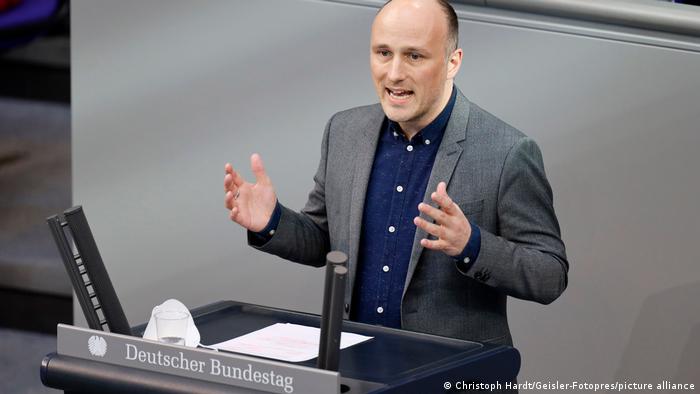
Green Party lawmaker Sven Lehmann has long been advocating for gender diversity and acceptance
Accepting his new position on Wednesday, Green Party politician Sven Lehmann said "everyone should be able to live freely, safely, and with equal rights."
In the newly created role of "Federal Government Commissioner for the Acceptance of Sexual and Gender Diversity," Lehmann will be responsible for working with government ministries on policy projects affecting the LGBTQ+ community. He will also spearhead the government's National Action Plan for Sexual and Gender Diversity.
Germany's month-old government — made up of the center-left Social Democrats (SPD), the Greens and the neoliberal Free Democrats (FDP) — previously set out the plan in their coalition deal. "Germany should become a pioneer in the fight against discrimination," the agreement reads.
Ensuring fundamental rights
In announcing his appointment, Lehman said that protection of all people regardless of their sexual and gender identity "must be ensured in accordance with the Basic Law" (Germany's constitution) and that "the fundamental rights of trans, inter and non-binary people must finally be fully enforced."
"We also need a broad strategy to combat hatred directed at groups — which explicitly includes 'queerphobia'," Lehmann said.
Driven by seeking justice
The 42-year-old parliamentarian has been a member of the Bundestag for the Greens since 2017. From 2018 to 2021 Lehmann served as spokesperson for queer policy and social policy within the Greens' parliamentary group, alongside Ulle Schauws.
"The issue of justice drives him," Schauws told DW. "That's why fighting for a life free of discrimination, for acceptance and diversity is like an engine that drives him."
Lehmann's close contact with rights groups and activists means he knows exactly what issues are affecting the queer community," she said.
"Even in discussions where there's criticism, he always has an open ear for what's important and what problems there are."
In the 2021 federal election, Lehmann won the direct mandate for his constituency in the western city of Cologne, which is home to one of the country's largest gay communities.
'Important signal'
Germany's Lesbian and Gay Association (LSVD) said the newly created office is "another important signal for the queer political awakening promised by the coalition government."
Lehmann has to become "the driving force in the government in order to implement the queer political projects promised in the coalition agreement," Henny Engels from the LSVD board told DW.
"Right now he should urgently endeavor to ensure that LGBTQ+ people are explicitly included in the admission program for refugees from Afghanistan, which was recently presented by Foreign Minister Annalena Baerbock," Engels said.
In December, Baerbock vowed to speed up the evacuation of those in need of protection in Afghanistan. Germany's action plan includes cutting back on bureaucracy to hasten the process.
Coalition pledges reforms
The German Society for Trans Identity and Intersexuality (dgti) also said it looked forward to working with Lehmann on the path to a "better world for all trans, inter and non-binary people."
In recent years, some changes have been initiated in this area of equality and diversity that can now be brought to a good end, dgti told DW in a written statement.
"From the dgti's point of view, this includes, above all, the abolition of the 'transsexual law' and the passage of new legislation on self-determination."
In 2018, Germany became one of the few countries worldwide that officially recognizes the existence of more than two genders when it introduced a third option, "diverse," in addition to "male" and "female."
In the new government's coalition deal, the three ruling parties pledged sweeping reforms for LGBTQ+ rights including an end to restrictions on blood donations by gay men, as well as legal changes to allow trans people to determine their own gender.








No comments:
Post a Comment