Monday, February 7, 2022

Because It’s Hard


Robert Royal

MONDAY, FEBRUARY 7, 2022


By a providential set of circumstances, I recently visited the Kennedy Space Center in Cape Canaveral, Florida. Take the kids to Disney World, if you will. But the Space Center has the right stuff.  Real stuff.

It features John F. Kennedy’s speech in 1962 at Rice University, a year before he was killed, committing America to go to the moon (video here):

But why, some say, the moon? Why choose this as our goal? And they may well ask why climb the highest mountain? Why, 35 years ago, fly the Atlantic? Why does Rice play Texas? We choose to go to the moon. We choose to go to the moon in this decade and do the other things, not because they are easy, but because they are hard, because that goal will serve to organize and measure the best of our energies and skills, because that challenge is one that we are willing to accept, one we are unwilling to postpone, and one which we intend to win, and the others, too.

JFK was not an exemplary Catholic, man, or president. And the “best and the brightest,” the whiz kids who gathered around him and bungled Vietnam and much more, were not what they imagined themselves to be. But they probably helped with the moon speech, and Kennedy delivered it with a clarity and emotion unmatched by any president since – with the exception of Ronald Reagan.

Watch the video clip; it’s astonishing, given the state of our leadership and public discourse today, that not all that long ago an American president could speak like that of measuring “the best of our energies and skills.” And that the American people responded to that kind of appeal.

Now, to be sure, the decision to go to the moon was part of the Cold War struggle against the Soviet Union. Russia, despite its manifold failures in many other areas, was significantly ahead of the United States in the space race. But even allowing for the political and military elements behind JFK’s speech, there was also something else, something timeless: an invocation of the heroic in a good cause, which always appeals to upright men and women, and often helps to create the very kind of human beings 

We take a lot for granted about the space program and tend not to value it much anymore. Journalists often criticize the clumsy bureaucratic side of NASA, an agency of the Federal government. Entrepreneurs like Elon Musk have shown that the private sector can vastly outperform government programs in both daring and innovation – who but Musk and his team thought you could make a reliable lift vehicle that would land upright on a barge and be reusable? And political activists sometimes dismiss the whole space adventure as a distraction from the work that needs to be done here on earth.

But those tentative early years still speak of something humanly great. And there was a price to be paid for such heroism. As JFK admitted in the same speech, he was proposing “the most hazardous and dangerous and greatest adventure on which man has ever embarked.” Gus Grissom, Edward White, and Roger B. Chaffee died less than five years later in a fire during a test on the launchpad for Apollo I. Two whole Shuttle crews were killed in terrifying accidents.

When Neil Armstrong walked on the moon, Mother Teresa – a woman hard to impress – remarked on the courage and skill it took. (She also is reported to have said that if there were the poor on the moon, her sisters would go there too.)

You cannot look at all this history and help but wonder: if we are capable – or once at least were capable – of doing such hard things in a secular pursuit, why do we not undertake the even harder and nobler task of getting ourselves to what St. Augustine called “the heaven of heavens”? Why do we seem to have few, if any, religious leaders who can issue a heroic call like the one that JFK pronounced on that singular day in Houston? Why do our people now seem deaf to such appeals?

G.K. Chesterton is often quoted about why it’s wrong to say that Christianity has been tried and found wanting; It’s been found difficult and left untried. Or rather we might now add, that was once the case. Besides efforts within the Church herself now to discard millennia of defined teachings in faith and morals, a more general attitude – almost an assumption – has crept in among us. Those hard Christian things are now often described, even by the highest Vatican authorities as “ideals.” We can’t, our leaders suggest, expect average Catholics to be Catholics.

Vatican II, in generous recognition of the dignity of all God’s faithful people, re-emphasized “the universal call to holiness.” (Lumen Gentium 5) We need mercy and forgiveness, to be sure, given our sins and errors. But we – all of us – have also been called to the hard stuff, the spiritual moonshot.

Life is hard. Death is hard. A Faith that does not respond to that has little to say to creatures in our fallen condition.

13 Enter through the narrow gate; for the gate is wide and the road broad that leads to destruction, and those who enter through it are many. 14 How narrow the gate and constricted the road that leads to life. And those who find it are few. (Mt. 7)

It’s only after you find “life” that you discover that, “my yoke is easy and my burden is light.” (Mt. 11.30) If you start with the easy, or assume that it ought to be easy, you’ll never develop the Right Stuff.

It calls to us because it’s hard, as it has called to people, against all earthly odds, for twenty centuries.


A FSAOF SUPPORTED MINISTRY


Sunday, January 23, 2022

The teachings of both basic biology and the Bible are now 'myths'...


With the passage of Bill C-4 (the "conversion therapy" ban), there is a great deal of concern among Canadian churches. Has the Trudeau government put a law on the books that effectively criminalizes Christianity? According to some prominent clergy in this country, the answer is, shockingly, yes.

In a letter published by Liberty Coalition Canada, a group of Evangelical pastors comments:

"This bill's wording is sufficiently broad to allow for the criminal prosecution of Christians who would speak biblical truth into the lives of those in bondage to sexual sins like homosexuality and transgenderism... Even a mother or father who offers their children freedom from sexual sin through repentance and faith in the gospel of Jesus Christ (1 Cor. 6:9-11) could be threatened with five years in jail."

The letter continues with a rebuke of Members of Parliament, who unanimously rushed Bill C-4 through the House of Commons last month without any debate or public input:

"Our King and Head is greatly displeased with our MPs for their sinful disregard for the spiritual and eternal well-being of Canadians. But it is important to note that they have also committed high blasphemy by referring to biblical teaching as 'myths' in this legislation. We all must therefore tremble to consider what terrifying judgments will be visited upon our nation for this bold gesture of hatred towards the most high God."

According to Bill C-4, which goes into force on January 8th, the Bible's teaching on sexuality and gender is defined as a "myth" under Canadian Law. The promotion and sharing of this biblical teaching will be a jailable offence that officially "causes harm to society".

CLC has been warning about the insidious danger of Bill C-4 (formerly Bills C-6, C-8, and S-202) for two years through our "Stop the Ban" campaign. The LGBT lobby, in bed with the mainstream media and Trudeau Liberals, has mounted a direct attack on the very foundation of the pro-family movement - the Word of God, which gives us God's plan for marriage and family. This attack not only puts faithful clergy and counsellors at risk of fines and imprisonment, it puts good parents in jeopardy as well.

Stop the Ban - Stop Bill C-4

Rev. Dr. Aaron Rock, pastor of Harvest Bible Church in Windsor, Ontario, notes: "In Canada, the teachings of both basic biology and the Bible are now 'myths', according to the preamble to Bill C-4 (conversion therapy bill)... This isn't about protecting people from harm, it's about the state playing the role of God. And, not a single MP objected to it, including several that claim to be Christian."

Rev. Dr. Joseph Boot, president of the Ezra Institute for Contemporary Christianity in Grimsby, Ontario, warns: "In Canada, Bill C-4 (anti 'conversion therapy' legislation) has just sailed through the House of Commons and Senate, criminalizing anyone - parent, pastor or therapist - who would dare counsel anybody to obey God's law with regard to human identity and sexuality. I will not comply with this law as a Christian leader, I cannot comply!"

Friday, January 14, 2022

<iframe src="https://www.facebook.com/plugins/post.php?href=https%3A%2F%2Fwww.facebook.com%2FDrAndyMiller%2Fphotos%2Fa.924081144282652%2F4486440328046698%2F&show_text=true&width=500" width="500" height="458" style="border:none;overflow:hidden" scrolling="no" frameborder="0" allowfullscreen="true" allow="autoplay; clipboard-write; encrypted-media; picture-in-picture; web-share"></iframe>

Monday, January 10, 2022

GERMANY

LGBTQ+ rights: Germany appoints first 'commissioner for queer affairs'

For the first time in the country's history, Germany has appointed a commissioner for the acceptance of sexual and gender diversity. Green Party lawmaker Sven Lehmann will oversee a LGBTQ+ national action plan.
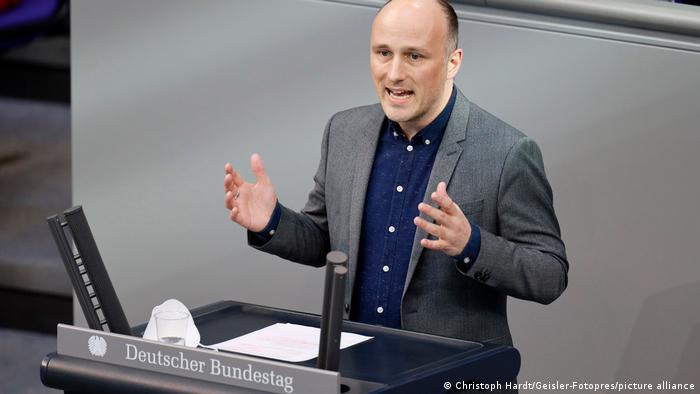
    
Sven Lehmann speaking in the Bundestag

Green Party lawmaker Sven Lehmann has long been advocating for gender diversity and acceptance

Accepting his new position on Wednesday, Green Party politician Sven Lehmann said "everyone should be able to live freely, safely, and with equal rights."

In the newly created role of "Federal Government Commissioner for the Acceptance of Sexual and Gender Diversity," Lehmann will be responsible for working with government ministries on policy projects affecting the LGBTQ+ community. He will also spearhead the government's National Action Plan for Sexual and Gender Diversity.

Germany's month-old government — made up of the center-left Social Democrats (SPD), the Greens and the neoliberal Free Democrats (FDP) — previously set out the plan in their coalition deal. "Germany should become a pioneer in the fight against discrimination," the agreement reads.

Ensuring fundamental rights

In announcing his appointment, Lehman said that protection of all people regardless of their sexual and gender identity "must be ensured in accordance with the Basic Law" (Germany's constitution) and that "the fundamental rights of trans, inter and non-binary people must finally be fully enforced."

"We also need a broad strategy to combat hatred directed at groups — which explicitly includes 'queerphobia'," Lehmann said.


0 seconds of 0 secondsVolume 90%
 
Watch video06:47

Pride and LGBTQ Germany


Driven by seeking justice

The 42-year-old parliamentarian has been a member of the Bundestag for the Greens since 2017. From 2018 to 2021 Lehmann served as spokesperson for queer policy and social policy within the Greens' parliamentary group, alongside Ulle Schauws.

"The issue of justice drives him," Schauws told DW. "That's why fighting for a life free of discrimination, for acceptance and diversity is like an engine that drives him."

Lehmann's close contact with rights groups and activists means he knows exactly what issues are affecting the queer community," she said.

"Even in discussions where there's criticism, he always has an open ear for what's important and what problems there are."

In the 2021 federal election, Lehmann won the direct mandate for his constituency in the western city of Cologne, which is home to one of the country's largest gay communities.

'Important signal'

Germany's Lesbian and Gay Association (LSVD) said the newly created office is "another important signal for the queer political awakening promised by the coalition government."

Lehmann has to become "the driving force in the government in order to implement the queer political projects promised in the coalition agreement," Henny Engels from the LSVD board told DW.

"Right now he should urgently endeavor to ensure that LGBTQ+ people are explicitly included in the admission program for refugees from Afghanistan, which was recently presented by Foreign Minister Annalena Baerbock," Engels said.

In December, Baerbock vowed to speed up the evacuation of those in need of protection in Afghanistan. Germany's action plan includes cutting back on bureaucracy to hasten the process.

Coalition pledges reforms

The German Society for Trans Identity and Intersexuality (dgti) also said it looked forward to working with Lehmann on the path to a "better world for all trans, inter and non-binary people."

In recent years, some changes have been initiated in this area of equality and diversity that can now be brought to a good end, dgti told DW in a written statement.

"From the dgti's point of view, this includes, above all, the abolition of the 'transsexual law' and the passage of new legislation on self-determination."

In 2018, Germany became one of the few countries worldwide that officially recognizes the existence of more than two genders when it introduced a third option, "diverse," in addition to "male" and "female."

In the new government's coalition deal, the three ruling parties pledged sweeping reforms for LGBTQ+ rights including an end to restrictions on blood donations by gay men, as well as legal changes to allow trans people to determine their own gender.

0 seconds of 0 secondsVolume 90%
 
Watch video05:46

'It's time for politicians to act'

The coalition also wants to see transition-related medical care fully covered by statutory health insurance and plans to create a compensation fund for trans and intersex people who were harmed by previous legislation, which included forced sterilization.

Prior to legal reform in 2011, trans people in Germany were forced to undergo sterilization to receive legal gender recognition.

"Some of these people suffer from these sex-assigning forced surgeries all their lives," the dgti statement read.

"Trans people who were only able to change their civil status after an adjustment operation must also be compensated. For many, this meant that their marriages resulted in a divorce or were annulled. Such action on the part of the state is against human dignity and human rights," the dgti said.

The creation of such a compensation fund would see Germany follow in the footsteps of European neighbors Sweden and the Netherlands.

Compensation has also been an issue with the Bundeswehr, Germany's army: In 2020 the Defense Ministry published a report on the extent of discrimination of gay soldiers before 2000. 

0 seconds of 0 secondsVolume 90%
 
Watch video03:56

German Bundeswehr's first transgender commander

'Example for EU neighbors'

Volker Beck, a Greens politician and former member of parliament, has praised the creation of the new post, even if it "comes somewhat late," he told DW.

Beck campaigned vehemently for the recognition of sexual diversity in the German parliament during his time as a Bundestag MP between 1994 and 2017. The first proposals for establishing a position similar to Lehmann's were already drawn up in the 1980s.

Looking to European neighbors, Beck said he hopes the position will be a "signal that gays and lesbians and sexual minorities are seen as citizens with equal rights."

Similarly, Lehmann's colleague Schauws said that while Germany still lags behind many countries on LGBTQ+ rights, she hopes the new government can lead by example for those even further behind. The new coalition has the task of ensuring that "people with queer biographies are finally taken seriously and the realities of diverse families are reflected in our laws so they can live free of discrimination."

"And this goes way beyond queer politics," said Schauws. "This applies to all forms of discrimination, and hatred towards specific groups that we experience in our country — and experience increasingly from right-wing groups. We have to keep a watchful eye on them and say: 'No, not in our country'."

Edited by: Rina Goldenberg and Kyra Levine

While you're here: Every Tuesday, DW editors round up what is happening in German politics and society. You can sign up here for the weekly email newsletter Berlin Briefing, to stay on top of developments as Germany enters the post-Merkel era.

DW RECOMMENDS