Monday, January 10, 2022

GERMANY

LGBTQ+ rights: Germany appoints first 'commissioner for queer affairs'

For the first time in the country's history, Germany has appointed a commissioner for the acceptance of sexual and gender diversity. Green Party lawmaker Sven Lehmann will oversee a LGBTQ+ national action plan.

    
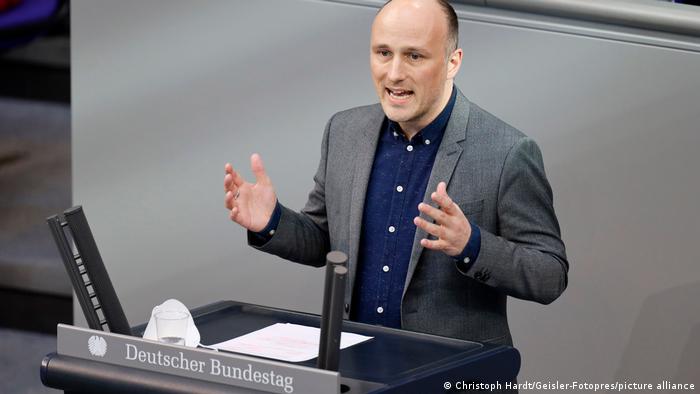
Sven Lehmann speaking in the Bundestag

Green Party lawmaker Sven Lehmann has long been advocating for gender diversity and acceptance

Accepting his new position on Wednesday, Green Party politician Sven Lehmann said "everyone should be able to live freely, safely, and with equal rights."

In the newly created role of "Federal Government Commissioner for the Acceptance of Sexual and Gender Diversity," Lehmann will be responsible for working with government ministries on policy projects affecting the LGBTQ+ community. He will also spearhead the government's National Action Plan for Sexual and Gender Diversity.

Germany's month-old government — made up of the center-left Social Democrats (SPD), the Greens and the neoliberal Free Democrats (FDP) — previously set out the plan in their coalition deal. "Germany should become a pioneer in the fight against discrimination," the agreement reads.

Ensuring fundamental rights

In announcing his appointment, Lehman said that protection of all people regardless of their sexual and gender identity "must be ensured in accordance with the Basic Law" (Germany's constitution) and that "the fundamental rights of trans, inter and non-binary people must finally be fully enforced."

"We also need a broad strategy to combat hatred directed at groups — which explicitly includes 'queerphobia'," Lehmann said.

0 seconds of 0 secondsVolume 90%
 
Watch video06:47

Pride and LGBTQ Germany


Driven by seeking justice

The 42-year-old parliamentarian has been a member of the Bundestag for the Greens since 2017. From 2018 to 2021 Lehmann served as spokesperson for queer policy and social policy within the Greens' parliamentary group, alongside Ulle Schauws.

"The issue of justice drives him," Schauws told DW. "That's why fighting for a life free of discrimination, for acceptance and diversity is like an engine that drives him."

Lehmann's close contact with rights groups and activists means he knows exactly what issues are affecting the queer community," she said.

"Even in discussions where there's criticism, he always has an open ear for what's important and what problems there are."

In the 2021 federal election, Lehmann won the direct mandate for his constituency in the western city of Cologne, which is home to one of the country's largest gay communities.

'Important signal'

Germany's Lesbian and Gay Association (LSVD) said the newly created office is "another important signal for the queer political awakening promised by the coalition government."

Lehmann has to become "the driving force in the government in order to implement the queer political projects promised in the coalition agreement," Henny Engels from the LSVD board told DW.

"Right now he should urgently endeavor to ensure that LGBTQ+ people are explicitly included in the admission program for refugees from Afghanistan, which was recently presented by Foreign Minister Annalena Baerbock," Engels said.

In December, Baerbock vowed to speed up the evacuation of those in need of protection in Afghanistan. Germany's action plan includes cutting back on bureaucracy to hasten the process.

Coalition pledges reforms

The German Society for Trans Identity and Intersexuality (dgti) also said it looked forward to working with Lehmann on the path to a "better world for all trans, inter and non-binary people."

In recent years, some changes have been initiated in this area of equality and diversity that can now be brought to a good end, dgti told DW in a written statement.

"From the dgti's point of view, this includes, above all, the abolition of the 'transsexual law' and the passage of new legislation on self-determination."

In 2018, Germany became one of the few countries worldwide that officially recognizes the existence of more than two genders when it introduced a third option, "diverse," in addition to "male" and "female."

In the new government's coalition deal, the three ruling parties pledged sweeping reforms for LGBTQ+ rights including an end to restrictions on blood donations by gay men, as well as legal changes to allow trans people to determine their own gender.

0 seconds of 0 secondsVolume 90%
 
Watch video05:46

'It's time for politicians to act'

The coalition also wants to see transition-related medical care fully covered by statutory health insurance and plans to create a compensation fund for trans and intersex people who were harmed by previous legislation, which included forced sterilization.

Prior to legal reform in 2011, trans people in Germany were forced to undergo sterilization to receive legal gender recognition.

"Some of these people suffer from these sex-assigning forced surgeries all their lives," the dgti statement read.

"Trans people who were only able to change their civil status after an adjustment operation must also be compensated. For many, this meant that their marriages resulted in a divorce or were annulled. Such action on the part of the state is against human dignity and human rights," the dgti said.

The creation of such a compensation fund would see Germany follow in the footsteps of European neighbors Sweden and the Netherlands.

Compensation has also been an issue with the Bundeswehr, Germany's army: In 2020 the Defense Ministry published a report on the extent of discrimination of gay soldiers before 2000. 

0 seconds of 0 secondsVolume 90%
 
Watch video03:56

German Bundeswehr's first transgender commander

'Example for EU neighbors'

Volker Beck, a Greens politician and former member of parliament, has praised the creation of the new post, even if it "comes somewhat late," he told DW.

Beck campaigned vehemently for the recognition of sexual diversity in the German parliament during his time as a Bundestag MP between 1994 and 2017. The first proposals for establishing a position similar to Lehmann's were already drawn up in the 1980s.

Looking to European neighbors, Beck said he hopes the position will be a "signal that gays and lesbians and sexual minorities are seen as citizens with equal rights."

Similarly, Lehmann's colleague Schauws said that while Germany still lags behind many countries on LGBTQ+ rights, she hopes the new government can lead by example for those even further behind. The new coalition has the task of ensuring that "people with queer biographies are finally taken seriously and the realities of diverse families are reflected in our laws so they can live free of discrimination."

"And this goes way beyond queer politics," said Schauws. "This applies to all forms of discrimination, and hatred towards specific groups that we experience in our country — and experience increasingly from right-wing groups. We have to keep a watchful eye on them and say: 'No, not in our country'."

Edited by: Rina Goldenberg and Kyra Levine

While you're here: Every Tuesday, DW editors round up what is happening in German politics and society. You can sign up here for the weekly email newsletter Berlin Briefing, to stay on top of developments as Germany enters the post-Merkel era.

DW RECOMMENDS


    Thursday, January 6, 2022

    God and the Gay Christian


    Matthew Vines, God and the Gay Christian(New York: Convergent Books, 2014) 213pp


    The response of churches to lesbian, gay, bi-sexual and transgender people is a hotly debated subject, both within and without church communities. In the churches, opinion is somewhat polarised between those accepting of people in same sex relationships and those opposed. The dividing line between or sometimes within churches is often drawn between those who take a conservative view of scripture and theology, and those of a more liberal persuasion. The former usually point to certain texts in both Old and New Testaments as prohibiting same-sex relationships, while the latter are sometimes more likely to regard such prohibitions as irrelevant to modern life, like the Levitical rule against eating shellfish.  

    What is distinctive about Matthew Vines’ defence of gay Christianity is that it is written by a gay Christian who is also a conservative evangelical with a high view of scripture. His claim is that “Christians who affirm the full authority of Scripture can also affirm committed, monogamous same-sex relationships.”

    There are six passages in the Bible which are taken as referring to homosexual behaviour, three from the First Testament and three from the New:  Genesis 19:5, Leviticus 18:22, Leviticus 20:13, Romans 1:26-27; 1 Corinthians 6:9 and 1 Timothy 1:10. Vines sets each in context and brings to bear upon them the consensus of scholarship. His conclusion is that none of them addresses the phenomenon of “committed monogamous same-sex relationships” as understood today. He supports this with an examination of the ways in which sexual relations were viewed over the centuries. In fact Vines claims that the Bible does not address, or condemn, same-sex orientation, which was not actually recognised as an issue until the twentieth century.

    Naturally not everyone will be happy with Vines’ conclusions. It might be argued that he is just selectively defending his own preference from Scripture and history. Quite apart from the fact that the same accusation could equally well be levelled at people taking the opposite position, it also has to be said that this writer is able to examine and critique unsustainable claims made by some sharing his own views. Others will suggest that regardless of the scholarship he brings to bear upon the particular Biblical passages in question, Vines misses the whole drift of Scripture which would lead to different conclusions. He, of course, argues precisely the opposite. The reader must judge.

    Vines’ introductory chapter sets his arguments in the context of the experience of young gay people growing up in conservative churches and trying to find their way, often with unhappy consequences as they often lose their faith and sometimes their lives. Those most willing to examine his arguments may be their friends and families, whose pain no-one should minimise. Claims to love the sinner while hating the sin can sound a little hollow when real people are involved. Vines’ own parents, who did not at first accept his position, came in due course to support him, even though it eventually meant leaving their church community for another. 

    Vines also suggests that we learn to adopt more eirenical language in our debates. He suggests that rather than “pro-gay” and “anti-gay” or “homophobic” or such expressions, all parties might adopt terms like “affirming” and “non-affirming”. This might help temper attitudes on both sides of the debate with a modicum of mutual respect. 

    This is a divisive topic for many church fellowships. Salvationists have the options of ignoring it and hoping it will go away, or of seeking to inform themselves as to the arguments and their implications. Recently the New Zealand Moral and Social Issues Council conducted a survey of Salvationist attitudes towards same-sex relationships, the Tri-Territorial “Thought Matters” theological conference in August is about “a Christian view of sexuality” and may therefore discuss the matter,and there is an unofficial ‘Salvos for a More Inclusive Church’ Facebook group on the web [Ed—email the editor for more information].All of these suggest that some are paying attention to this subject.  

    Salvationists ought to be well-informed and it would be a good thing if we were able to discuss the issues, about which inevitably there will be differences of opinion, without the painful and personal divisions encountered in some other places. Matthew Vines’ God and the Gay Christianis a book which could be recommended to conservative Christians who want to work out a balanced view of the matter and are prepared to consider respectfully and dispassionately views and arguments with which they may not agree.