Margaret Watson It took me so long to come back Ingrid. When I met my husband we were high in the Himalayas . We were older, not much time left to have children. Someone from IHQ said John could come back to England and be a candidate there - there being no SA where we were.I was only visiting to study. So we married and he completed his contract with the Church Missionary Society. We returned to the UK and were envoys while John was a candidate. We had a divisional farewell for him to go to the ITC. Then we heard nothing. So I asked the D.C. He contacted NHQ to be told that Commissioner Cachelin had changed the upper age limit. very recently. John was now a few weeks too old. We did continue as envoys for a while, but some of you in the UK will remember the storm of 1987. It destroyed the hall and the corps closed. No ne offered us any support. It took me almost 30 years to face coming back.
Wednesday, October 2, 2019


Monday, September 30, 2019
There are no atheists in a situation like that!

Eighteen months later, as I stood on top of Everest mesmerised by the incredible curvature of the earth from the top of the world's highest mountain, it was just natural to feel, 'Wow, God, you made all this?' I guess that is worship. And what a privilege to climb mountains with the One who made them.
My Christian faith has so often been a quiet backbone to our life as a family and through my work.
My Christian faith has so often been a quiet backbone to our life as a family and through my work.
When I took President Obama into the Alaskan wilderness for an episode of Running Wild, it was a special moment to finish the adventure by praying together. Out in the wild you discover pretty quickly that even the most famous, extraordinary people are asking the same questions and looking for the same things in life as all the rest of us.
It was another president — Abraham Lincoln — who once confessed, 'I have been driven to my knees many times by the overwhelming conviction that I had no place else to go.' Smart and humble man.
Bear Grylls
Bear Grylls
Friday, September 27, 2019
Call the Midwife I.

William Booth Memorial Training College - London
Margaret Watson
College Brigade
1972
A soldier of Christ, still in the fight.
Flying Solo 1971
O.K. not exactly flying. I was on a bus, one of the wonderful red Route Masters heading for Dalston Junction. Crawling along if truth be told. But we got there eventually – me and my bag. My first ever solo home delivery awaited. All I had was a name and an address and the contents of my bag. That and a few months training.
The address was on the very edge of our district so I hadn’t been there before. It turned out to be a maisonette in a newish block, probably built on a plot where a German bomb had removed the previous building. Dalston wasn’t yet the trendy area it was going to become. The block stood alone among derelict industrial units, a guard dog was tied to the gate and there was a stale smell from some broken sewer nearby. But someone had planted a rose bush and the nets at the window hadn’t yet acquired the usual grey look.
The lady was beautiful in a slightly faded way, with dark hair and huge eyes in a Spanish dancer sort of appearance, enhanced by the large hooped earrings she wore. Not young. She already had eight children . 45 or so, she was a bit vague, so probably even older. The children who still lived at home peered round her skirts. She grabbed her handbag and pulled out her purse. ‘Off you go Josie. Nurse is here now. Get this lot to school and we’ll have fish and chips tonight. You can get them on the way home – but don‘t pick holes in the paper and eat them in the street.’
The children disappeared within minutes after the usual ‘Can’t find my shoe!.’ and we got on with the job. Her name was Carmen – so the Spanish theme persisted. She hadn’t booked a delivery, or been to antenatal clinics or classes, because I think she knew that , at her age, and with blood pressure problems, a hospital delivery would be advised, or even insisted on. But then who would look after all those children? Josie was only about 12 and she didn’t look too bright, and in those days a baby meant ten days in hospital.
‘I knew I was ready so I phoned.’ As far as Carmen was concerned that was all that was necessary. And after eight previous births she had everything required. A brand new pram blocked the hall. ‘I treated myself.’ The boys used the other one to bring home the coal from the railway tracks.’
Things progressed quite quickly. If all my home deliveries were going to be like this it would a doddle ( They weren’t, but that is a whole book full of other stories. ). After only two hours since the phone call James Conrad Tafferty arrived in a rush. He was a good size with lots of dark hair and a loud yell It was still only just after ten a.m. I tidied up, parcelled up the afterbirth , made and drank tea and said ‘I’ll be back about 2 30.’ And I was out of the door and heading for the bus stop.
There was a clinic to attend , but well before three I returned. The children presumably were still at school. Carmen was drowzing on the bed with baby tucked up close . There would be no problems with getting him to take a feed.
I hadn’t been in the house more than a few minutes when I aware that there was someone else in the next room. Just then the bedroom door opened and a young man, a boy really, about 15 , entered. He stripped off his shirt, then his trousers and he climbed into the bed. It seemed only seconds later and he was snoring.
‘Who is that?’ I asked quite shocked.
 ‘Oh, don’t worry about him. It’s the baby’s father. He’s just finished his stint at the market. He bought home some lovely bananas.
MARGARET WATSON
Former SA Officer
Served in Pakistan and the UK
Call the Midwife II
Changing times?
Someone asked me today if conditions in the East End of London had changed much since the days of William Booth. Well I haven’t been back for many years , and I’m not quite old enough to have lived in the 19th century, although I do know some of it has become quite gentrified with chic boutiques and penthouse apartments ( you can hardly still call them flats ) going for many million.
That hadn’t happened in the early 1970’s when I was a midwife there. You could still buy live chickens in the market , and they’ d cut off its head for you, tossing the loose head to the cobbles, but the stall was right in front of Tesco’s. There had been other changes of course – we had antibiotics and electric lights, but some of those lights still depended upon someone having a sixpence for the meter. I kept a supply of coins for such occasions, and a torch and matches just in case.
Hot water was harder to find than you might think. I delivered one baby in a fifth floor, one room flat where a brocaded double bed filled most of the room. I got out my kit while a very small toddler looked on. The only water supply was a cold tap in the basement. The toilet a floor higher, but shared by far too many people. The immediate problem though was that this woman was terrified and sobbing. Her cousin had just had triplets only a few weeks earlier, two tiny boys and their bossy older sister. I always wondered how they turned out.
But now this lady, Turkish, we were getting a lot from that part of the world. Jewish families had moved further north and were being replaced by migrants from other places. The West Indians had come a few years earlier, but now we were getting Turks, Iranians, a Bolivian family , Brazilian married to a Spaniard without knowing anything of each other’s mother tongue, those with no English at all whose had to be translated – often by small children. There were more, all finding homes in our patch.
Fatima Ahmet was really, really scared that she too was going to have triplets . ‘My belly very big. It runs in families. I have heard.’ Nowadays she would have had a scan at 12 weeks to reassure her , but they were still very new in those days. Most doctors were unlikely ever to have seen one, let alone be able to interpret the results with any assurance. The Mother’s Hospital where I was based didn’t have either a scanner or someone who knew how to operate one. I would, several times a week, have to ring up the nearest scanning department , after a morning’s antenatal clinic. But it would take an age to get someone to answer the telephone as they were too busy with the scanner – several rooms away from the telephone. They didn’t seem to have a receptionist, or if they did she was away at her lunch break. I worked out one week I spent three and a half hours trying to get a response for your two ladies. All three and a half hours were my lunch hour.
This lady, not surprisingly, had never had a scan. For one thing she had only ever been to booking clinic soon after she realised she was pregnant. We didn’t see her again until her neighbour phoned to say she was in labour. This was more common than you would think. Husbands changed jobs and people moved frequently. Besides she’d had her first child at home in Turkey with just her grandmother to help. That was O.K. so she’d manage this time too, until she panicked, I could understand her thinking , even if I didn’t agree with all of it. The clinic nurse might want blood checks, or find something wrong – some reason to bring her into hospital. And it was five flights down and then a long walk to the bus, and she’d have to change buses once she got to Stoke Newington – all to be told everything was fine. And there were still the five flights to climb when she got home with toddler and the week’s shopping, all on a rainy day.
I reassured her about the rarity of triplets and let her hands follow mine as I examined her so she could feel one baby’s head and one baby’s spine. A big baby, so no room for any others. I never did deliver that baby. Nothing much happened while I was with her , and eventually a colleague relieved me.
I did however see Fatima Akram in the post-natal clinic. She wanted a coil fitted, but this was a different woman to the one I had met a few weeks earlier. She was s relaxed and happy, proud of her beautiful son, with his thick black hair and curling eyelashes. I was just bending over to admire them when we were interrupted . The ‘big sister’, aged two by now , wanted her lunch. She fished in her mother’s dress front, and pulled out a huge breast , the nipple dripping with milk.. ‘It’s OK ‘ said her mom .I’ve got two of them.’, and she opened her dress further and placed number one son on her other breast.
Why did she have a home delivery? Because that is what she wanted would be the easy answer. It was normal in her community. Also when the phone call comes it isn’t the time to discuss the matter. Yes, her home was unsuitable. Yes, her facilities were inadequate. Yes, there wasn’t room even for two people , let alone four, but that wasn’t going to change in the immediate future. This baby would be coming home to that crowded room. Things were as clean as she could manage. At least this way she had a properly trained midwife at hand, who could if necessary call an ambulance and arrange for that hospital admission.
If a home birth had been refused, what would have happened? She might well have tried to go it alone, or with her elderly neighbour as her only support. Her husband would be out with his mates or at work. Births were little to do with men in those days. Even though it was permitted at the hospital, very few men actually came into the room while their wives gave birth, preferring to pace the corridor outside. So somethings have changed.
A soldier of Christ, still in the fight.

MARGARET WATSON
Priest. at The Old Catholic Apostolic Church
Former SA Officer

MARGARET WATSON
Priest. at The Old Catholic Apostolic Church
Former SA Officer
Saturday, September 21, 2019
Thursday, September 19, 2019
Tuesday, September 17, 2019
Whitechapel was ‘home’and I liked it. 1991
A New World
 |
| WHITECHAPEL 1865 |
The doors opened and I faced a large man, face with several days of stubble and grey hair straggling past, well past, his shoulders. He grinned.
‘Come on lady. Let’s get you out of there. There’s strawberries for tea.’
‘Tea’ was in large mugs, several with interesting chips, rather than the dainty tea cups I was used to, but it tasted great and the strawberries might have been rejects from the market, but we didn’t care. I had arrived.
Above me the shiny new Booth House , opened by the queen not long before and , across the yard , towering grim heights of Victoria Homes.
My bit was tucked in, just in front of the grim façade. A corridor of rooms designated as the Alcoholic and Drug Rehabilitation Unit, even if, in those days, we knew relatively little about dealing with either - at least we were trying. At one end my accommodation – the smallest dwelling I would ever occupy. A bedroom just big enough to take my bed and a squeeze past, a sitting room where two were a crowd, and a tiny kitchen, just wide enough to hold a Baby Belling,. Turn round and you were in a shower room and toilet. But however small, I was glad to get out of that van.
I was in the strange position of being neither staff nor client. I was about to begin my training as a midwife, but as a qualified nurse, my presence in the unit meant that scheduled drugs needed could be kept on the premises.
My midwifery training course wouldn’t begin for another three days. Time for me to get used to my surroundings. William Booth knew that men were unlikely to listen to the gospel while they had holes in their shoes, nowhere to sleep, and empty bellies. Victoria Homes had been built as a result. It accommodated about 600 men if my memory is correct, sleeping in long dormitories with very little space between the beds. It was awful to my eyes. Imagine trying to sleep with dozens of other men, snoring, screaming at night mares, delirium tremens and all the rest. But these men had been in the forces and it was warm and dry. Many actually said they preferred it to the shiny new building with its single room accommodation, something they weren’t used to, and didn’t want to get used to either. It was what they were used to.
But the new place was full too, with an every changing population, though some stayed for years. And then there were the others. The folk who slept in the deserted graveyard nearby. We could see their fires and night, and hear the fights, though in the day time it seemed deserted unless you looked very closely and saw a body lying flat in the long grass between the tombs, waiting until the alcohol wore off the its owner would rise once more in search of fresh supplies.
Over the next weeks and months I listened to many stories. The men seemed to adopt me as a younger sister cum agony aunt. If I meet homeless people these days younger faces predominate, but in those days almost all the men had been to war – whether the Great War, the Second World War or Korea, or even some other long forgotten conflict. It didn’t matter. The result had been the same. They had returned home to be rejected . Someone else was sleeping in their bed. Or perhaps the house didn’t exist any more and no one knew what had happened to the occupants. Or they had just moved, and , with poor literacy rates, no one had written. I had many relatives who went to war, all seven of my uncles, but they came home to loving wives and sweethearts – not these men. And so had begun broken lives which had somehow collected, like debris blown by the wind, along the Whitechapel Road.
Every fortnight or so a doctor visited – these men were not likely to register with a GP and so he came to them. On Sundays there were services in a dusty hall with a slightly out of tune piano and a very indifferent pianist. A mini bus would ferry some to nearby army citadels, but most didn’t go anywhere.
On Tuesday morning I led sharing sessions. No one had to come and no one had to share, but many did. There were exceptions to the ‘I came home and’ stories. There was the prof who taught history at a local university. He could be fine for months and then out would come his purple shirt and he would be off on a bender which could last for weeks. He didn’t know why that shirt was such a trigger, but he wouldn’t get rid of it, determined that one day everything would be o k., and in the meantime we always found room for him. There was also Mike , a somewhat younger man than our average. Tall and much too thin, he had a ready smile and a gentle voice,. He was kind and made the perfect cuppa just when it was needed. He was qualified as a printer and was willing to teach others his trade, this being long before the automation of the newspaper industry and its move to Wapping. He was a husband and father, a son and an uncle, and somewhere out there his family were waiting for him. But he was also the only one I was physically scared of - when he thought his drugs weren’t going to be available doors would be smashed, chairs thrown, windows broken , even the reinforced ones, and just once he tried to strangle me to get the keys.
It wasn’t a quiet place. You could hear the traffic whizzing by on the Whitechapel road, unaware of the lives existing so close to its kerbs. There was a faulty alarm which went off regularly and continued for hours, always beginning at three a.m. We were close to Middlesex Street , or Petticoat lane as it was better known. On market days barrows would begin to roll across the cobbles in the lane behind my bed head at an hour long before my usual getting up time. We were only yards for the London Hospital and ambulances wailed past at all hours.
I had only visited London on two occasions before my arrival in Whitechapel. Then it had been the tourist sights. The statue of Boudicca, a quick tour of Westminster Abbey, a visit to the Stranger’s Gallery in the House of Commons, a walk along the Thames by lamplight in the evening. The theatres and museums were still there of course – the National Gallery, Trafalgar Square and all the rest. Carnaby Street and Kensington High Street were only a bus ride away. he Tower of London was only a short walk from my flat
 But then and there the East End and its people were so much more interesting. If I came out of the front door to my right was where John Wesley had felt ‘strangely warmed.’ To my left, just past the Mission to the Jews, was the Beggar’s Bush, by then the unofficial headquarters of the Kray Gang, but outside which a relatively young William Booth had been invited to preach more than a hundred years earlier.

I was also ‘home’and I liked it.
Margaret Watson
Former SA Officer UK
Margaret Watson
Former SA Officer UK
Saturday, September 14, 2019
Jesus recruited everyone to be involved in His mission
To be a disciple of a rabbi in a Jewish system, you had to be the best of the best. You had to jump through a lot of hoops for a temple rabbi to invite you to “follow me.”
It’s interesting that when Jesus started his ministry, he changed the reality of disciple making. He shifted the requirement from being about moral motivation, to himself being the motivation.
He empowered people who didn’t fit the established temple/disciple mould. He connected with “unclean people,” those whom Jewish society wouldn’t have allowed to get anywhere near the temple to worship God. For example, the tax collector, Matthew, would not have made the cut because his profession and the port where he collected taxes were a disgrace to the Jews.
Jesus called the disgraced Matthew to “follow me.” “Follow me” is what a rabbi says to the best of the best.
So, when Jesus called the worst of the worst to follow him, he sent a strong message to the Jewish religious establishment that the mission had shifted. It was now not only for the Jews, but for everyone. This not only showed Matthew how special he was to God, but even more radical, that he could be a respected missionary of the gospel and socially reconciled because of Jesus.
Jesus opened up the requirements for what it meant to be a disciple.
He simply saved and then sent, simplifying discipleship to what he originally intended.
Why did he do this? I believe it was for intentional missional strategy. He made this change because God’s answer to problem solving is involving all kinds of people.
Jesus recruited people who spoke the cultural language of those around them and didn’t let anything get in the way of his movement. He started a passionate and internally motivated kingdom movement, got rid of the movement blockers, and empowered people to share the good news that the Trinity would restore everything.
He recruited everyone to be involved in his mission without discrimination. In a Salvation Army context, the idea of becoming a disciple is similar to becoming a soldier. To become a Salvation Army soldier, you have to do soldiership classes, promise to live a high and moral life where you’re not going to drink alcohol and smoke, etc.
Here’s the problem: Jesus would make a great adherent. Soldiership not only excludes Jesus but it also excludes the majority of people within our society who don’t wish to make these lifestyle promises. Many people will say, “What’s the problem? That’s why we have adherency, which caters to people who don’t want a ‘higher calling.’ ”
However, this higher calling creates a two-tier exclusiveness, which Jesus opposed, and allows for unbiblical power and segregation problems within community.
The adherents in my ministry setting are as equally passionate and active followers of Jesus as our soldiers, except the adherents can’t become officers because they are not soldiers. They would argue that they are genuine soldiers because they have encountered Jesus, and he has transformed their lives to the point where they now partner in the mission of God.
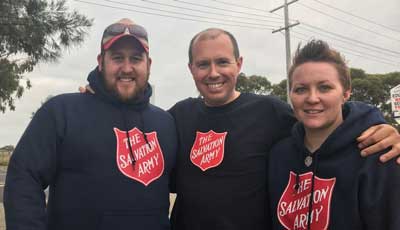 Cpt Peter Hobbs (centre) asks whether we have made soldiership too exclusive
Well, the answer is to be like Jesus: remove the blockage and model a different reality. Soldiership would then be something close to: Anyone who follows Jesus and acknowledges his presence in their life and who is part of our Salvation Army family on mission together is a soldier in The Salvation Army.
The benefit of empowering all people into a soldiership journey with Jesus like this is that it creates an environment of equality without condemnation, simplifying soldiership to what Jesus originally intended.
When soldiers are raised by being on mission with Jesus, we will also see a radical increase in spiritually mature apostolic and prophetic leaders in The Salvation Army—the type of leaders who pioneer movements.
I’m aware this is a controversial topic within The Salvation Army, but no more controversial than it was for Jesus when he introduced it to Judaism 2,000 years ago.
Imagine existing volunteers as partners in the mission. And those faithful adherent elders and leaders at our centres who have never been able to be soldiers because of a few lifestyle choices, now being seen as mainstream missionaries in The Salvation Army. Not only mainstream missionaries, but our future leaders and officers.
If ever the world needed a movement of soldiers it is now. The only requirement is Jesus, and he is enough.
Captain Peter Hobbs is a corps officer at Bellarine Peninsula in the Australia Territory.
Reprinted from others Magazine (Australia).
Reprinted from others Magazine (Australia).
Wednesday, September 11, 2019
(Translation: Sven Ljungholm)
A corps was opened in Moscow in 1918 and there I discovered the Army
While (stationed) at the International training college I was asked by the General to represent the Army at various conferences; one of the most interesting was the Conference of European Churches that met in the autumn of 1964. The late Commissioner Tor Wahlström, then leader in Denmark, accompanied me. The event was unique because of the unusual circumstances under which we met. Originally it was intended to hold a conference in the Danish town of Aarhus, but as the German Democratic Republic would not permit their citizens to enter territories or states belonging to the North Atlantic Treaty Organization a new strategy had to be devised that would make it possible for East German Christians to attend. Finally it was decided to charter the M.S. Bornholm and station it in the Kattegat in neutral waters beyond the jurisdiction of any NATO nation.
Later that evening, at our first meal on shipboard, I shared a table with two U.S.S.R. delegates, an elderly bearded pastor and a young woman, both fluent in English. The pastor told me he entered the ministry of his evangelical church before the October 1917 Bolshevik revolution, and had been well acquainted with Commissioner Karl Larsson, a Swedish Salvationist who had close links with the Army (SA) in Russia prior to and for some time after the revolution. In point of fact, as early as 1913 Larsson introduced the Army to Russia – the Army’s official history says “almost by holy subterfuge!”
Taking advantage of a Hygiene Exhibition in Saint Petersburg (now Leningrad) he presented a Salvation Army display in the Finnish Pavilion. It created considerable interest, and from such a small beginning Salvationism took root and grew slowly but steadily until by 1917 North Russia was recognized as a full-fledged SA Territory.
A corps was opened in Moscow, (in 1918) and there my new acquaintance met Larsson and discovered The Army with its flags, happy singing and fervent proclamation of the gospel.[1]
The Moscow corps was opened in October 1918 by my grandparents and no doubt the Gospel heard was that shared by the corps officers, Adjutant Gerda and Otto Ljungholm, in their broken Russian but “fervent proclamation”, along with others. See page 140-41: “Whenever I walk by that old building where Salvationists held their Moscow meetings those long years ago,” he told me, “I invariably pause for a moment of thanksgiving to the Lord, for it was there I learned to know him better and to love him more deeply.”
He told me that nearly a hundred songs from the Salvation Army songbook are to be found in his Church’s hymnary, including the Founder’s “O Boundless Salvation.”[2]
General Clarence Wiseman
Subscribe to:
Posts (Atom)